Finding low competition keywords is a smart SEO strategy that helps the sites, especially new or small, gain visibility without competing with the best classification domains. These Keywords usually have lower search volume but can direct traffic highly targeted to your site. By identifying them and using them, you can create content that classifies faster and resonates better with your specific audience. Here we discuss How to Find Low-Competition Keywords for SEO
Importance of low competition keywords in the SEO
Low competition keywords play a crucial role in the effective SEO because they allow you to be higher with less effort. Instead of fighting for high volume competitive keywords, you can focus on terms that fewer sites are segmenting. Not only does this increase your chances of appearing on the front page of the search results, but it also helps to attract more qualified visitors – people more likely to get involved with your content or make a purchase.
7 ways to find low competition keywords
Okay, now that you know what low competition keywords are, it’s time to find the low-hanging fruit to help you start ranking in the search engines for relevant keywords with business potential.
1. Use a keyword research tool
You can use numerous keyword research tools to discover low competition keywords, including Surfer’s keyword research tool for topical maps. Enter a relevant keyword or phrase, and the tool generates numerous keyword clusters for various blog topics. The tool displays the overall difficulty of your main keyword and the difficulty of all keywords in a given cluster. When choosing a keyword, look for a low keyword difficulty and a low-to-medium monthly search volume. These are typically the easiest keywords to target (I cover this in more detail later in this article with real examples).

2. Analyze Google’s SERP features
Google has several useful SERP (search engine ranking positions) features to help you find relevant low competition keywords. In particular, Google Autocomplete can help you find long-tail keyword suggestions, which often contain less competition than other keywords. Search a relevant keyword or phrase in Google to find low competition keywords using Autocomplete. For instance, I can use the keyword, “long run distance.”

When I search this keyword in Google, it suggests other keywords and topics. These are keywords and queries that other people are actively searching for. Take note of all relevant keywords—these can either form an article or be included in a topic cluster to help you drive more traffic to a particular article.
You can also use the “People also ask” section, found on the first page of Google. The questions shown are also queries people are searching for and contain potential key phrases to add to your keyword research.
This can be useful for finding more keywords and possible low competition topics.

Finally, scroll down to the bottom of the search results and find related searches. Again, this may include low competition keywords and topics to add to your topical map.

3. Target emerging topics
Often, emerging topics are a low competition keyword gold mine. This is because emerging topics do not have existing competition, and nobody is established on the topic. AI and space travel are examples of emerging topics. New details are appearing on both topics, which were previously not covered because they did not exist. Despite this, it can be more difficult to find keywords on emerging topics as very few keyword and competitor data are available. Instead, it’s more a case of finding emerging topics rather than finding the “right” keywords to include in your content.
4. Cover trending content
Writing trending content and topics is an excellent way to drive traffic to your website. It can help you land on Google News or Discover. For example, the Tour de France Femmes avec Zwift just revealed the route for this year’s event. Cycling News wrote an article about it, which is featured on Google News.

5. Use TikTok’s “Others Searched For” tab
TikTok’s “Others Searched For” tab is a hidden gem for finding low competition keywords. Many people forget that social media apps are also search engines—they can be very useful for finding keywords (as long as you don’t end up doom-scrolling).
To start:
- Search a relevant term or keyword in the TikTok search bar
- Scroll down to the “Others Searched For” tab
- Select relevant keywords
You can repeat this process with the keywords you discovered using the “Others Searched For” method to find even more keywords. This keyword research method is similar to the “People also search for” section on Google. However, discovering keywords this way usually contains lower competition as the data is directly from TikTok’s data and is typically not targeted by other creators.

6. Use Forums and Niche Communities
Forums and niche community sites, such as Reddit and Quora, are useful for finding valuable questions and trending topics in a given niche. For example, let’s say you’re in the running niche. You can then browse posts on the subreddits to find topics to cover. You can filter by “hot” or “new” to potentially discover trending topics, which you can write about to potentially be featured on Google News or Discover.

You can also perform a custom Google search using search modifiers to find relevant questions. Search modifiers include terms such as:
- How
- What
- Where
- When
To perform a custom Google search, use the term, site: “site name” / “keyword”.

7. Research your organic competitors
You can also use your favorite keyword research tool to research your organic competitors and discover low competition keywords. Typically, this involves entering your competitor’s URL into a keyword research tool and filtering to find low difficulty keywords. Tools like Surfer also allow you to sort and categorize keyword data using filters such as search volume, website authority, and keyword difficulty. If you don’t know your competitors, you can enter a URL into Surfer and see who is ranking for similar keywords.

How to evaluate low competition keywords
Once you’ve completed the above steps, you hopefully have an initial keyword list of potential low competition keywords. However, you should evaluate your keywords before using them to help you get the most out of your content strategy (i.e., not wasting resources targeting the wrong keywords). Therefore, I explain three criteria for evaluating and selecting the best low competition keywords below.
1. Keyword difficulty
The best way to see whether a keyword is worth targeting is the difficulty of ranking the given keyword. Low competition keywords mostly include a low keyword difficulty (KD)—for a tool such as Surfer, anything below 20 or 30 is generally considered low competition. You can target keywords towards the higher end of the difficulty indicator. However, these will be more difficult to rank for, especially if you’re a small business or are just starting with your website.

2. Search volume
Low difficulty keywords indicate low competition. If there are no monthly search volumes for your keywords, they may be a waste of resources to target. It’s also worth noting that the estimated traffic from various keywords is often higher than expected. Why? This is because the keywords are low competition and have not yet been crawled sufficiently. Likewise, you will also rank for relevant keywords without necessarily targeting them, often generating more traffic to your article or webpage.

3. SERP Analysis
Finally, there’s SERP Analysis—where you get your hands dirty and physically analyze the top results to gauge competitiveness.
Search your chosen keywords on Google, and look for:
- Poor quality content
- Low domain authority
- Outdated information
- A poor page experience
You should also analyze the search intent of your primary keywords to ensure they match the intended search intent (this is the “why” behind the search). If SERP analysis is skipped, you can miss out on easy to rank for keywords or may target the wrong search intent, which is a waste of resources.
3 examples of low difficulty keywords
I’ve selected various keywords from multiple niches using Surfer to further show you how to identify low difficulty keywords.
1. Poker cash games

The keyword difficulty is located at the top right and scores a keyword difficulty of 7. This is relatively easy to rank for but contains enough total traffic (787) to justify targeting in your content.
2. Events for small businesses
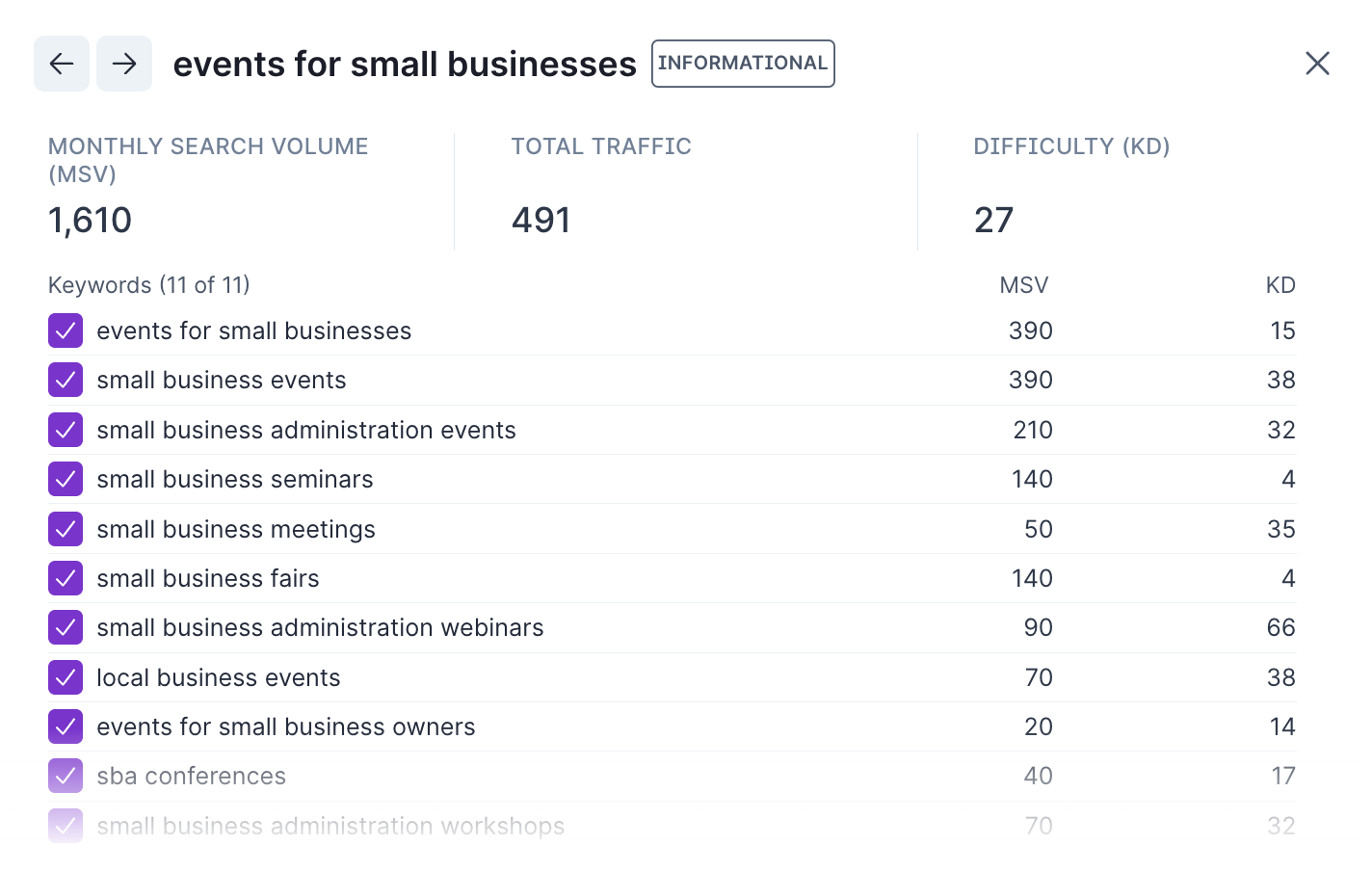
The keyword difficulty for the above keyword is 27.
This is towards the higher end of the recommended bracket for low competition (less than 20 to 30) but is still doable. Again, the total traffic and monthly search volumes are high enough to justify writing.
3. Webinars for small businesses

Finally, we have an example where the keyword difficulty for the chosen keyword is 30. This is within the upper limit of what I consider a low-difficulty keyword. Despite this, the keyword difficulty for some of the secondary keywords is as high as 36 and 41. The total traffic and monthly search volumes are also much lower, so I’d avoid choosing this keyword unless it makes up part of a content cluster and you have the resources to dedicate to it.