An eCommerce business doesn’t happen overnight. You will have to compete with market leaders prevailing in the market over a long period of time. Nevertheless, your task is to push your business further. Of course, you will have to do lots of business-related things. Invest tons of money and time. However, you can’t put your arms around everything. Hence, you need to figure out those factors that matter the most. What are they? In this post, you will get familiar The Three Most Important Ecommerce Success Factors.
1. Low customer acquisition cost
Getting boatloads of profitable customers for cheap is the holy grail for most ecommerce businesses. How low is low enough mainly depends on your preferred margin, lifetime value, and your competitors. The biggest part of this cost is the marketing expense to get a new customer. Even if you’re not actively spending money on things like advertising, each new customer still has a cost. At first, you can get away with simply spending your own time. But if your business is more established, you will likely hire experts or staff to do the marketing for you.
Brand

This is the fuzziest but most impactful way to stand out and lower your acquisition cost.
- How many people have heard of your brand & know what it stands for?
- How are you different from your competitors?
- Why would a potential customer be triggered to check out your store?
Measurement
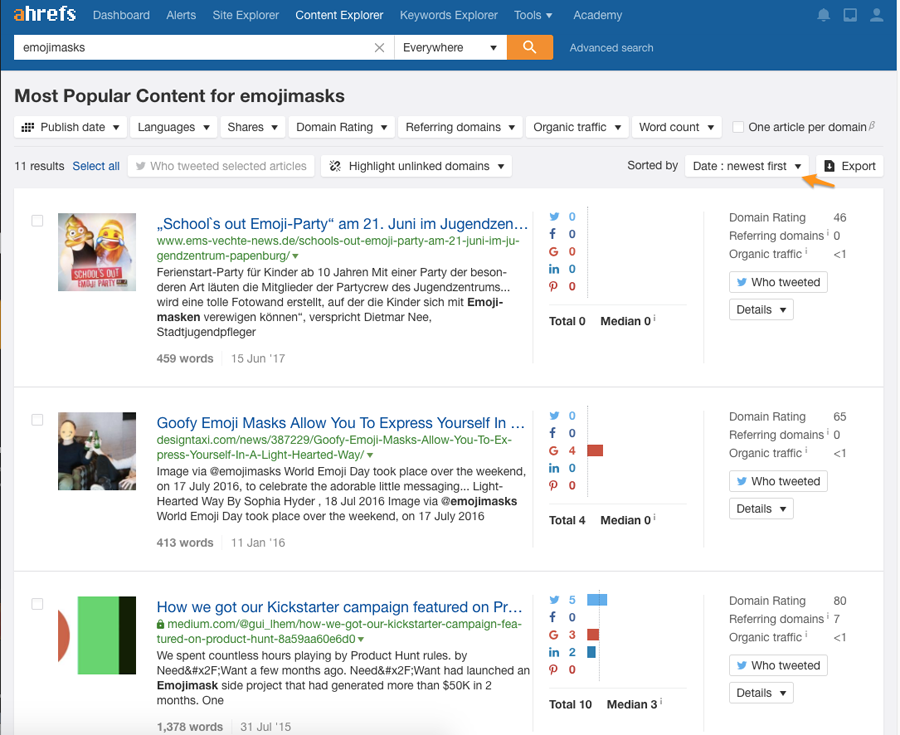
As mentioned above, brand building can seem pretty esoteric. But there are some effective ways to measure if you’re doing things right. Branded search traffic, and especially its trend over time, can function as a good indicator of increased brand awareness. Another reliable indicator is brand mentions. Every time your brand is mentioned, your reach expands. Certainly, not all mentions are equal, but consistent growth in this area will help to reach more potential customers.
MARKETING
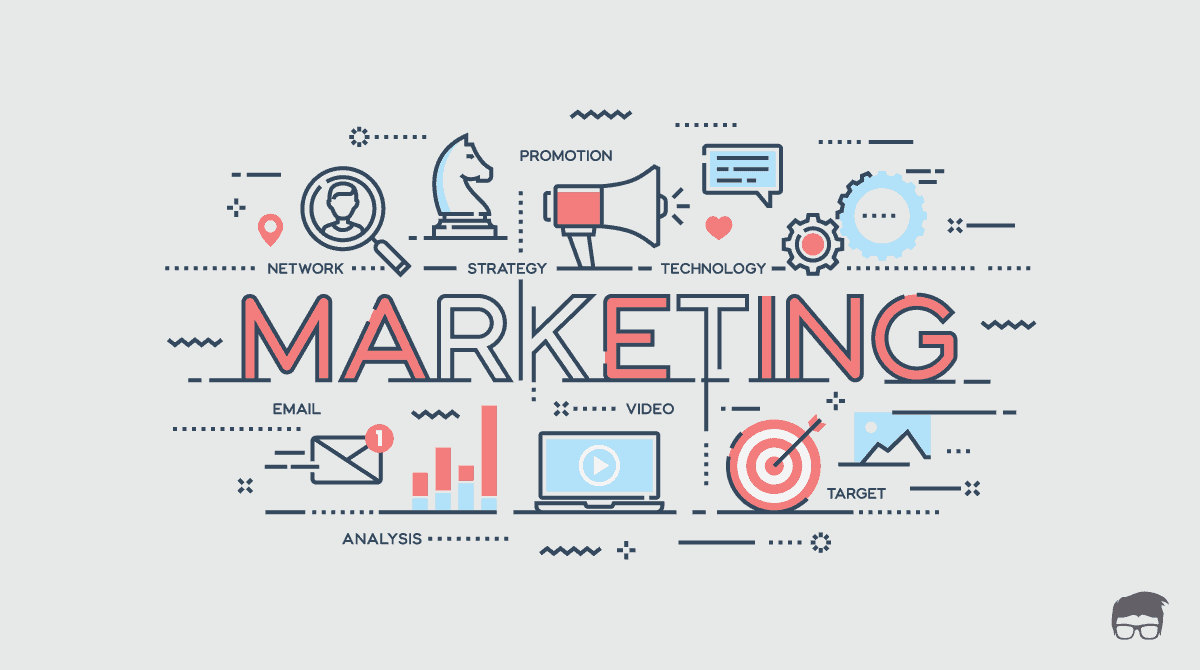
Creating a strong brand means deciding what you stand for, and also what you don’t stand for. That means that you’ll have a better idea of who to target, and where to find these people. That’s a good starting point when it comes to marketing. So how do you stretch your budget as far as you can? When we researched the most effective ecommerce marketing tactics, we discovered two low or no-cost approaches to increase sales:
- You focus on marketing activities that are cheap: email & retargeting. But these are also low scale, meaning that the total volume of sales from these activities will be limited.
- You do things differently.
2. High repurchase rate
Repeat orders are what the most successful stores are built on. Research by RJ metrics revealed that the best ecommerce companies generate more than half of their total revenue from repeat customers after 20 months. And it starts contributing more to revenue than new customers afterwards.
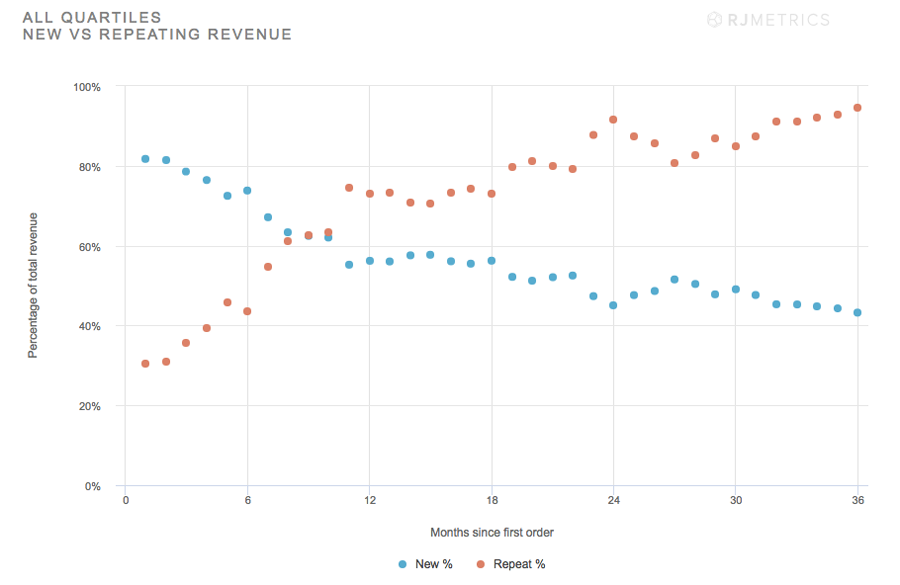
This factor increases the lifetime value for your ecommerce customers, which is great for profits. Customer loyalty is something that’s the sum of a lot of important parts: customer experience, product selection, pricing, brand, and marketing. Notice how I’ve put marketing last. Because the most common approach to increase customer loyalty is simply get more in front of your existing buyers.
Customer experience

Customer service should be at the top of your if you want to improve the customer experience. Making sure existing clients are happy is the bar. This will also generate more customer reviews. If you have a customer support person or team, make sure you also know what’s going on. But the whole customer experience already starts when a visitor lands on your site. How hard is it to find specific products? How enjoyable is it to browse through your product selection? How fast is the site? How easy can they find your “meta” information like shipping costs or contact details?
Product selection
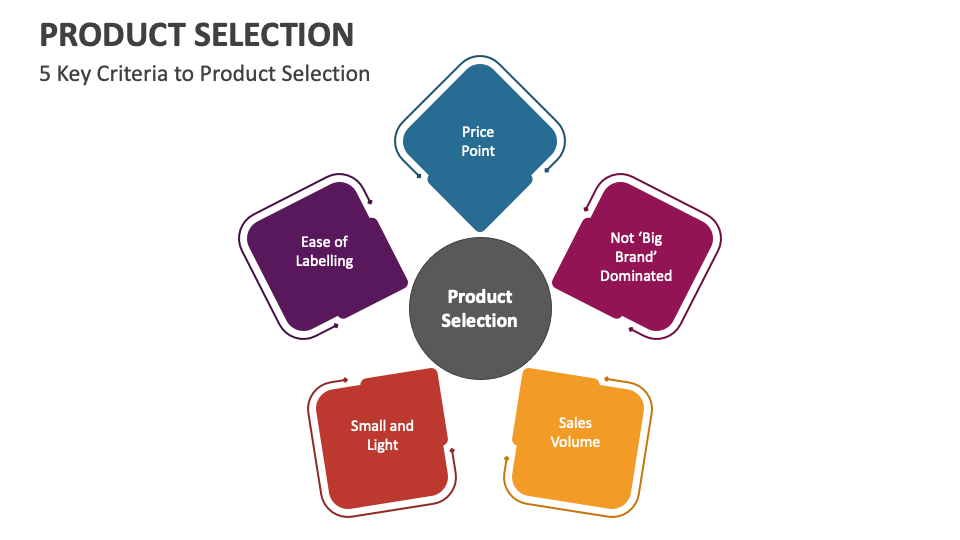
If you’re a marketer, marketing is probably what comes natural to you. But really, it’s the product that needs to come first. That might sound super obvious, but when I started my career, I’ve beaten myself up over the marketing results when the actual problems were with the product. It’s simple: to sell more, you need products that people. Getting your product selection right has an enormous impact on your conversion rates and on you repurchase rates. Picking and promoting the right products is a skillset which isn’t talked about, but it’s of vital importance.
3. Healthy margins

A healthy gross margin makes your ecommerce business easier to run. (As a benchmark, a Marketing survey found gross margins averaged between 22% and 38%). It gives your room to invest, offers more possibilities to acquire customers. This important factor is made up out of two numbers: revenue and cost. We’ve already looked at a piece of that cost: your marketing expenses. But of course, there are also other costs involved like product cost, shipping, and other expenses.
Selling higher priced products
It might come as a surprise, but it’s not that much harder to sell a $2,000 coffee machine online vs a $19 anti-age face cream. Even if your margin is lower, the total profit per order will be a lot higher on the first product.
Upsell / cross-sell
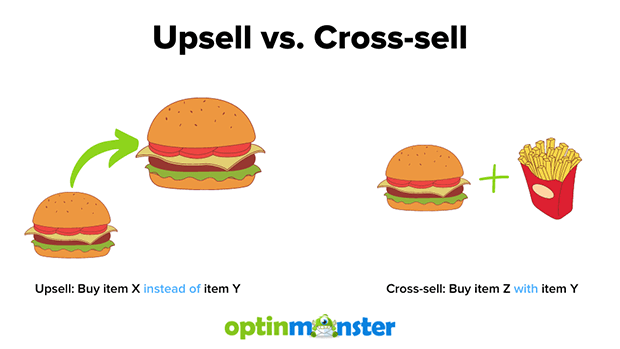
Cross selling is selling complementary products like a $15 bottle of cleaning fluids for that $2,000 coffee machine. Or try bundling your cheaper products for a high price like these poop emoji masks. Normally, they will sell for $7.99 each. But the site thought that maybe people would want to buy 15 of them for a party. They sell that for $69.99, a price per unit to $4.6, a lot lower, but I’m sure these bigger orders are more profitable for them.